AI Interviews Compared: New Meta-Analysis Shows Positive Effects

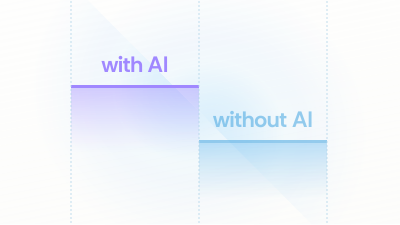
While individual studies often produce mixed results, a recent 2026 meta-analysis (Springer Nature) provides a clearer overall picture. Instead of focusing on single experiments, it combines multiple studies—revealing a more nuanced outcome.
The Study: Overview of the Research Landscape
The meta-analysis examines so-called technology-mediated interviews—interviews supported by digital or AI-based systems.
Data basis:
- 24 studies
- 31 independent samples
Focus areas:
- candidate perception
- fairness
- emotional reactions
- functional evaluation
Key Finding: Functional Advantages of AI Interviews
One central result of the analysis:
👉 Candidates rate AI-supported interviews more positively in functional aspects than traditional interviews.
These include:
- efficiency
- structure
- clarity of the process
AI interviews are therefore often perceived as more organized and consistent.
No Disadvantages in Fairness or Emotional Reaction
A particularly relevant point:
👉 There are no significant differences between AI and traditional interviews when it comes to:
- perceived fairness
- negative emotional reactions
This means:
- AI interviews are not perceived as less fair
- they do not trigger stronger negative emotions
These results contradict the common assumption that AI automatically leads to worse candidate reactions.
Perception of Innovation and Modernity
The study also shows:
👉 Technology-mediated interviews are often perceived as more innovative and modern.
This can impact:
- employer branding
- positioning as a modern employer
Acceptance Is Multi-Dimensional
An important insight from the meta-analysis:
👉 The perception of interviews consists of multiple dimensions:
- emotional reaction
- fairness
- functional evaluation
The results show:
- Emotional reaction → similar to traditional interviews
- Fairness → no significant difference
- Functionality → advantages for AI interviews
Interpretation of the Results
The meta-analysis suggests:
👉 AI interviews are not simply evaluated as better or worse—
they are evaluated differently.
- Traditional interviews → more emotionally driven
- AI interviews → more strongly evaluated based on functional benefits
Conclusion
Key takeaways:
- AI interviews are perceived as more efficient and structured
- no significant disadvantages in:
- fairness
- emotional response
Overall:
👉 there is no clear acceptance barrier among candidates
These findings make an important contribution to the current discussion:
AI interviews are not fundamentally an acceptance problem—
but rather a question of design and implementation.
TL;DR
- Meta-analysis with 24 studies (2026)
- AI interviews perform better in functional aspects
- no disadvantages in fairness or emotions
👉 AI interviews are perceived in a differentiated way—but overall neutral to positive by candidates.

Ready to Hire Smarter?
See how lizzyAI transforms your recruiting process — from screening to selection.


@ lizzyAI 2026