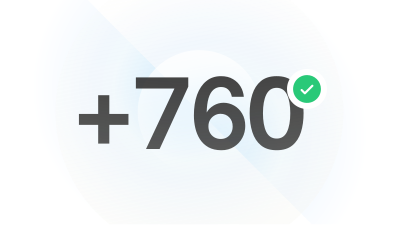
AI Interviews Are Perceived as Fairer – New Study with 760 Applicants

👉 AI interviews can be perceived as fairer than human interviews.
The Study: 3 Experiments, 760 Participants
The study “Applicant reactions to AI-based interviews” systematically examines how candidates react to AI interviews.
Study design:
- 3 controlled experiments
- total sample: 760 participants
Comparison:
- AI-based interviews
- human interviews
👉 Goal: To understand when and why candidates accept AI interviews.
Key Finding: AI Interviews Increase Perceived Fairness
The most important result of the study:
👉 AI-based interviews lead to higher fairness expectations among candidates.
This means candidates are more likely to assume that AI:
- evaluates more objectively
- is more consistent
- is less influenced by personal biases
👉 A critical point, since fairness is one of the most important drivers of acceptance in recruiting.
Why AI Interviews Are Seen as Fairer
The study identifies two key mechanisms:
1. Standardization
AI interviews:
- ask the same questions
- follow clear structures
👉 Result: less arbitrariness in the process
2. Reduced Subjectivity
Compared to human interviews:
- less influence of personal sympathy
- fewer spontaneous biases
👉 Candidates therefore expect a more neutral evaluation.
But: Acceptance Is Not the Same for Everyone
One particularly interesting insight from the study:
👉 The perception of AI interviews depends on the candidate.
- Candidates with strong cognitive abilities:
→ view AI interviews especially positively
→ expect high fairness - Candidates with strong social / interpersonal skills:
→ are more concerned that their individuality may be lost
👉 Conclusion: AI interviews are perceived differently—but not fundamentally rejected.
What This Means for AI Interviews
The study highlights an important shift:
👉 AI is not only accepted—
👉 in certain contexts, it is even evaluated more positively than humans
This challenges many traditional assumptions.
Connection to Other Recent Studies
These findings align with recent field experiments:
- In a large study with ~70,000 candidates:
→ 78% voluntarily chose AI interviews - Candidates rate:
→ AI and human interviews similarly in quality
👉 Together, this creates a clear picture:
AI interviews are not only accepted—
they can be actively preferred.
Conclusion: Fairness Is the Key to Acceptance
Key takeaways:
- AI interviews create higher expectations of fairness
- Candidates perceive AI as more objective and consistent
- Acceptance strongly depends on individual profiles
👉 The key insight: Not the technology itself—but how it is perceived.
What This Means in Practice
This leads to a clear strategy for AI interviews:
👉 Successful AI interviews must:
- feel fair
- be transparent
- follow structured processes
Because these factors drive acceptance.
TL;DR
- Study with 760 participants (3 experiments)
- AI interviews are perceived as fairer
- Fairness is the most important driver of acceptance
👉 AI interviews are not the problem—
👉 they are an opportunity to make recruiting more fair.

Ready to Hire Smarter?
See how lizzyAI transforms your recruiting process — from screening to selection.


@ lizzyAI 2026