How a Global Facility Management Leader Scaled Frontline Hiring
How a Global Facility Management Leader Scaled Frontline Hiring with AI Interviews
Hiring at scale is challenging in any industry. But for organizations that rely on thousands of frontline workers every month, hiring is not just an HR function - it is business-critical infrastructure.
This case study highlights how a global leading facility management company with 40,000 employees worldwide used AI Interviews with lizzyAI to modernize high-volume frontline recruiting across locations, improve candidate reach, and fill roles faster - without relying on resumes.
Company Overview
This organization is one of the world’s leading facility management providers, operating across a large international footprint and supporting customers in sectors such as:
- Commercial real estate
- Industrial sites and logistics
- Retail and public facilities
- Healthcare and critical infrastructure
With 40,000 employees globally, their workforce is the foundation of service delivery. As demand fluctuates across regions and customer contracts, the company needs to hire continuously - and often urgently.
The Hiring Context: Tens of Thousands of Frontline Positions
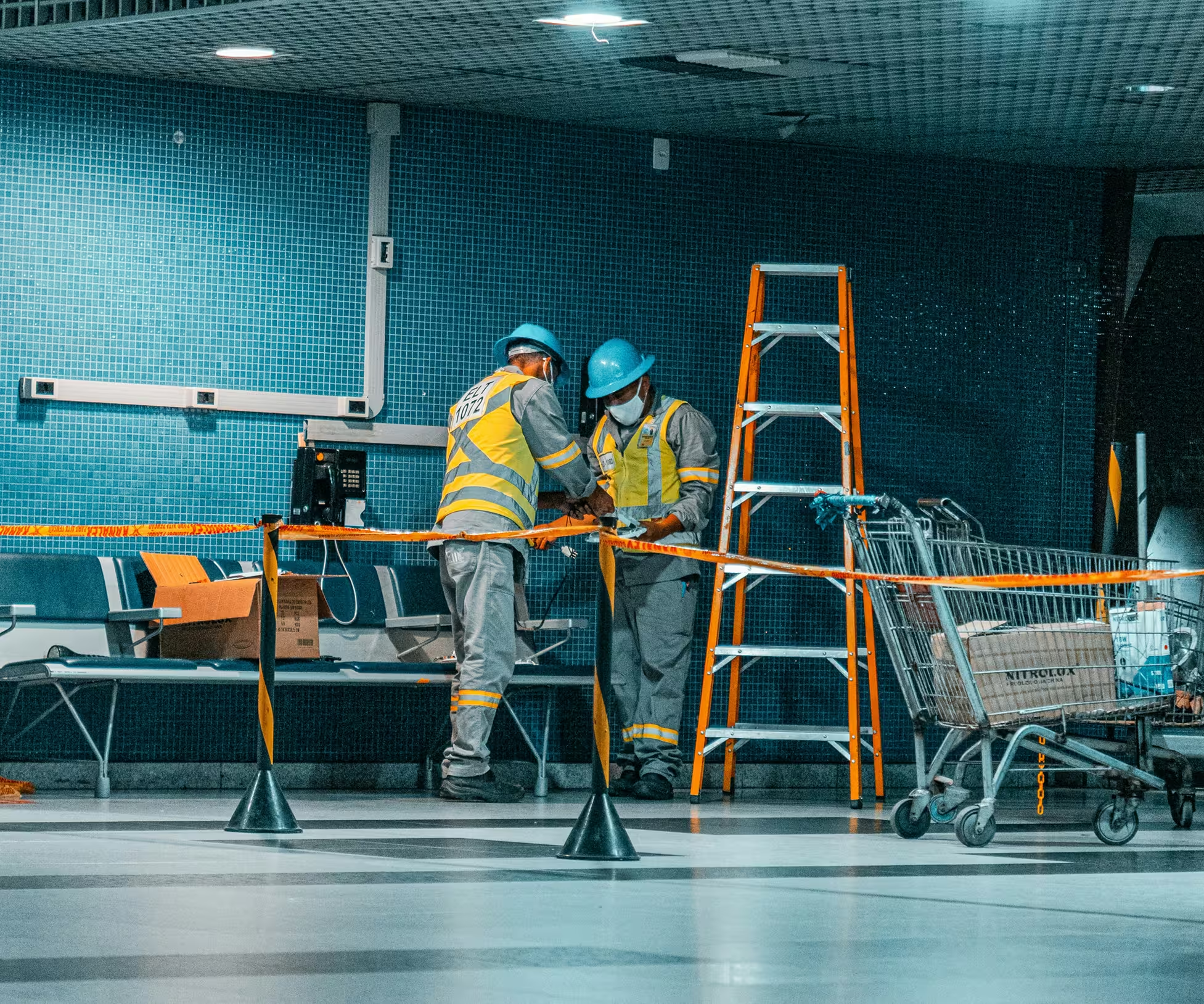
The company was hiring tens of thousands of frontline roles across many locations, including positions such as:
- Cleaners and janitorial staff
- Maintenance technicians
- HVAC and electrical support roles
- Security guards and site supervisors
- Landscaping and outdoor maintenance staff
- Warehouse and logistics support workers
The challenge was not finding a few great hires - it was building a system that could deliver hiring outcomes repeatedly, across every region, without breaking under volume.
The Challenge: High-Volume Hiring Without Reliable Resumes
Frontline hiring looks very different from corporate recruiting.
Many qualified candidates do not have polished resumes - and in many cases, they do not have a resume at all. Even when resumes exist, they often do not reflect real-world capability, reliability, or fit for shift-based work.
The facility management company faced several compounding challenges:
High turnover and constant backfilling
Frontline roles often experience higher turnover due to shift work, physical demands, and seasonal fluctuations. This creates a constant need to hire and replace talent quickly.
Resume-based screening was unreliable
Traditional resume screening was not a strong indicator of job success for many frontline positions. Candidates could be great workers but struggle to document experience formally.
Hiring teams were overwhelmed by volume
Recruiters and operations managers were handling large numbers of applications across multiple locations, often under time pressure to meet staffing requirements.
Inconsistent hiring processes across sites
With many sites and regional teams involved, it was difficult to maintain consistent screening standards. Hiring outcomes depended heavily on local capacity and individual processes.
Speed mattered - but quality still mattered
Delays in hiring could lead to understaffed sites, missed service levels, and operational stress. But rushing hires without proper screening increased early attrition and rework.
Why AI Interviews Were the Right Fit for Frontline Hiring
In frontline hiring, the key questions are often simple - but critical:
- Can the candidate reliably show up and work required shifts?
- Do they have relevant experience or transferable skills?
- Are they eligible and ready to start soon?
- Do they understand the job expectations?
- Are they a fit for the work environment and team needs?
The issue was not that these questions were hard to ask. The issue was asking them consistently, at scale, across dozens or hundreds of locations, while keeping time-to-hire low.
That is where AI Interviews became a game-changer.
The Solution: Hiring Across All Locations with lizzyAI
The company implemented lizzyAI to standardize and scale their screening process using AI Interviews.
Instead of relying on resumes as the primary filter, they used lizzyAI to create a more inclusive and scalable hiring approach - designed specifically for frontline recruiting.
With lizzyAI, the company was able to:
Run AI Interviews across all locations
Recruiting teams could deploy a consistent screening experience across sites, without needing every location to build its own process from scratch.
Screen candidates without requiring perfect resumes
Candidates could demonstrate fit through structured interview-based evaluation rather than being eliminated due to missing or incomplete resumes.
Improve consistency across regions
Hiring teams aligned around the same evaluation criteria, reducing the variability that comes from fragmented processes.
Reduce bottlenecks in early-stage screening
Instead of recruiters spending most of their time on repetitive pre-screening, lizzyAI helped them focus on moving the right candidates forward faster.
Support operational hiring needs at scale
The company could handle fluctuating hiring demand across sites more smoothly - without adding chaos to the recruiting workflow.
The Outcome: Faster Hiring, Better Reach, Stronger Hiring Operations
The impact was felt across recruiting and operations.
While the company did not focus on a single metric, the qualitative outcomes were clear:
Reached more candidates who would have been missed
By removing the resume as a hard requirement, the company expanded access to qualified workers who were previously filtered out by traditional screening.
Faster fill rates for urgent roles
Hiring teams were able to move candidates through the funnel more efficiently, helping sites get staffed sooner and reducing operational pressure.
A smoother candidate experience
AI Interviews created a more structured and accessible first step for candidates, especially those who are not used to formal corporate hiring processes.
More consistent screening across sites
Recruiting leaders gained greater confidence that candidates were being evaluated against the same standards, regardless of location.
Reduced recruiter workload and less repetitive work
Recruiters spent less time on manual pre-screening tasks and more time coordinating hires, supporting hiring managers, and keeping pipelines moving.
Why This Matters: The Future of Frontline Hiring Is Not Resume-Based
High-volume frontline hiring is one of the most operationally complex recruiting challenges in the world.
And it is not solved by adding more manual work.
This case study shows a clear shift happening in the market:
- From resume-based screening
- To structured, scalable AI Interviews
- That help companies hire faster, more consistently, and more fairly
For facility management companies, the value is immediate:
- Staffing improves
- Service delivery stabilizes
- Hiring becomes predictable across locations
- Recruiters can operate at scale without burnout
Key Takeaways
A global facility management leader with 40,000 employees needed to hire tens of thousands of frontline workers across locations.
Their biggest challenges included high turnover, resume limitations, and overwhelming screening volume.
With AI Interviews powered by lizzyAI, they achieved:
- Better candidate reach without relying on resumes
- Faster hiring outcomes across multiple locations
- More consistent screening standards across regions
- A more scalable recruiting operation built for frontline hiring
Want to Scale Frontline Hiring with AI Interviews?
If you are hiring frontline roles across multiple locations and struggling with volume, turnover, or resume-based screening limitations, AI Interviews can help you build a faster and more reliable hiring process.
lizzyAI helps high-volume employers streamline screening, improve consistency, and hire at scale - without sacrificing candidate quality.

Ready to Hire Smarter?
See how lizzyAI transforms your recruiting process — from screening to selection.


@ lizzyAI 2026